
A C Driving Tuition
Angela Cahill ~ Driving Tuition
South Kildare & Carlow
I am a RSA Approved Driving Instructor (ADI). I initially trained with and worked for Airport Driving School in the late 1990s. In 2001 I joined the Driving Instructor Register (DIR) of Ireland and alongside another Registered Driving Instructor (RDI) set up A2B School of Motoring in Dublin. I am now living in South Kildare and cover South Kildare and Carlow.
Driving Lessons Info and Cost
Once you have passed the Theory Test and have a valid Learner Permit you are eligible to start taking driving lessons with a RSA ADI.
Essential Driver Training (EDT)
The RSA put in place the Essential Driver Training programme, also known as EDT in 2011. It is mandatory to complete a minimum of 12 EDT lessons with an ADI prior to applying for the driving test. How many lessons a person requires in order to reach test standard is very individual. The RSA recommends at least three hours practice in between the EDT lessons. If you are in a position to practice between EDT lessons then you may require less hours with an ADI to reach test standard.
In my experience, and from the feedback I receive, two hour lessons are more beneficial, particularly so in the early days when learning a new skill. When more experienced one hour lessons may be sufficient.
An EDT logbook will be given to you on your first lesson and is included in the cost.
To view your EDT lessons click here
For more information on the RSA EDT programme click here
Reduced EDT programme: Click here.
1 hour €50
2 hour lesson €95
Make sure you have your Learner Permit and Logbook with you for each lesson.
Mock test & Pre-test (warm up) lessons including car hire for the driving test.
Mock test (2hrs) €95 ~ Pre-test lesson (1hr) including car hire for driving test €150 ~ Standard pre-test lessons €50/€95
- A mock test can be taken in your car or the school car. It is advisable to take a mock test well in advance of your driving test date in order to have time to address any issues you may have.
- The Instructor will play the role of the examiner.
- A full colour graded pre-test learner driver assessment sheet will be used to record any driving faults.
- Following the mock test your Instructor will provide a detailed explanation of the results and advise you on the best way forward.
- To avail of the school car hire for the driving test, your driving must be up to a high standard.
- Once you receive an invitation to book the driving test, check with your Instructor prior to choosing a time and date to ensure that they are available for pre-test lessons and car hire if applicable.
- Motorway lessons are an option available to you once you have passed your driving test.
1
1 hour pre-tes lesson including car hire for driving test €150
111
Ca
Driving Lessons – Basic info
Lessons can be taken in a dual controlled car or in your own car if deemed appropriate.
Full one hour or two hour lessons (no dropping off or picking up other pupils during your lesson)
A lesson will consist of a brief introduction and explanation of what the lesson will entail. You will then get to put the skill into practice. This will be followed by a short debrief and a plan for the next lesson – if applicable.
Make sure you have your Learner Permit with you for each lesson
1 hour €50
2 hour lesson €95
Contact Info
If you would like to find out more or book a lesson
Phone/Text or WhatsApp: 087-9711350
Alternatively, you can fill out the form below. Whether you call, text, email or fill out the form below. I may not be in a position to answer/reply straight away. However, l will get back to you as soon as I can.


Essential Driver Training (EDT)
Note: Reduced EDT programme includes lessons 1,5,6,7,9 & 10.
EDT Lesson 1: Car Controls & Safety Checks
EDT Lesson 2: Correct Positioning 1
EDT Lesson 3: Changing Direction 1
EDT Lesson 4: Progression Management
EDT Lesson 5: Correct Positioning 2 (more complex situations)
EDT Lesson 6: Anticipation & Reaction
EDT Lesson 7: Sharing The Road
EDT Lesson 8: Driving Safely Through Traffic
EDT Lesson 9: Changing Direction 2 (more complex situations).
EDT Lesson 10: Speed Management
EDT Lesson 11: Driving Calmly
EDT Lesson 12: Night Driving
Some useful links
RSA Driver Theory Test Site. Here you will find information on how to prepare for and book your Theory Test: https://theorytest.ie/
RSA NDLS (national driver licence service). Here you will find information on how to apply for your Learner Permit or Driving Licence once you have passed the driving test: https://www.ndls.ie/learner-driver/my-first-learner-permit.html
My EDT Portal. Here you will find information on how to access your EDT portal: https://www.rsa.ie/services/learner-drivers/my-edt-portal
The Driving Test in Ireland. Here you will find information on how to apply for your driving test, driving test eligibility, available test centre locations etc. https://www.rsa.ie/services/learner-drivers/the-driving-test/what-it-is
Updates related to the Driving Test: From March 9th 2026 all driving test candidates must present on the day a valid motor insurance certificate as proof that they are covered to drive the vehicle they intend to use for the driving test. When hiring a driving school car the Instructor will provide the necessary documentation.
The Day of the Driving Test
Arrive at the test centre in good time, at least 15 minutes prior to your appointment. Park your car in a designated RSA test applicant parking space. Head into the test centres waiting area and wait for your name to be called. When it is time for your test to begin, you will be asked to produce your Learner Permit and read and sign a statement confirming that the vehicle used for the test is roadworthy, and that the insurance cover is adequate. Note: From the 9th of March 2026, all learner drivers presenting for the driving test will need to show evidence that they are insured to drive the vehicle they will use for their test. For more information see here
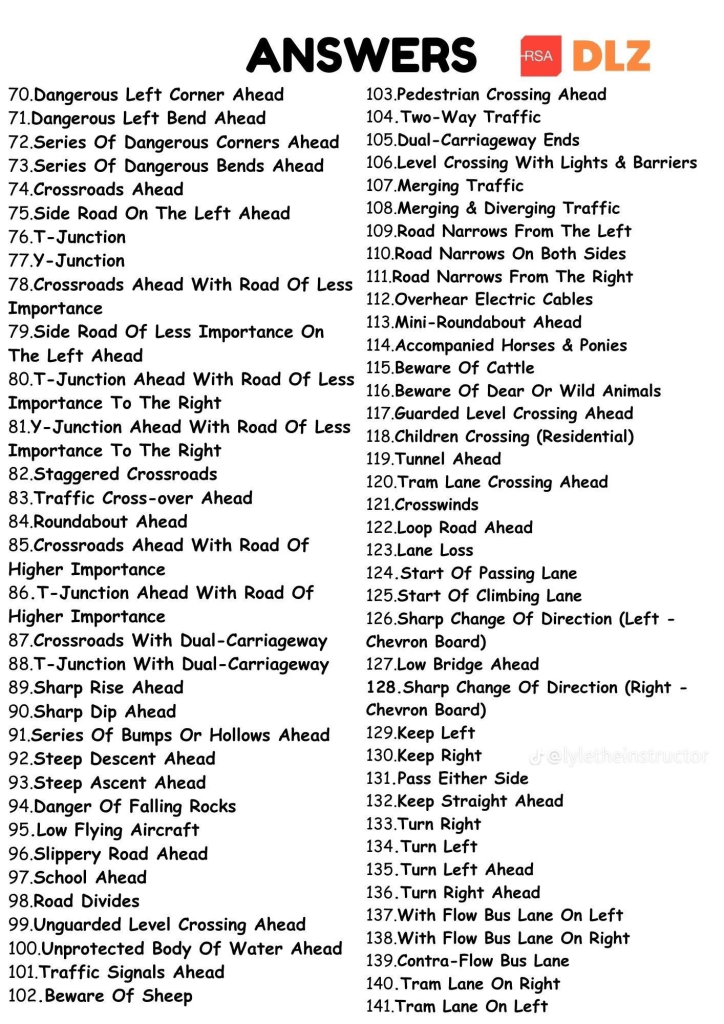
You will be asked to answer some questions on the rules of the road and to identify some road signs. As from April 14th 2025 you will also be asked to demonstrate two randomly selected hand signals. Prior to this they were demonstrated following the Turnabout manoeuvre. I have compiled a list of some commonly asked questions, including road signs below. Prior to the drive you may be asked to open the bonnet and answer some basic questions on the engine. The tester will then check that the brake and indicator lights are working – you sit into the car and turn on the engine for this. Your tester will then sit into the car and ask you to identify and demonstrate some of the internal secondary controls.
Where 3 or more questions are not answered, or are incorrectly answered, a grade 2 fault will be recorded. Where a” Checks” fault is incurred in relation to the Doors, Mirrors, Seat, Seatbelt, or Head- Restraint adjustment as per the preamble requirement, it will be recorded opposite Rules / Checks and is inclusive of any oral test Faults. Make sure to brush up on the rules of the road prior to the test. You do not want to have a grade 2 fault before you even start the driving part of the test!
The Driving Test Report Sheet is graded as follows:
Grade 1 fault = Minor fault. (Grade 1 faults do not affect the test result) *Note* Grade 1 faults will no longer be included in the Test Result Report Sheet (April 2025)
Grade 2 fault = More serious fault. Grade 3 fault =Dangerous/Potentially Dangerous fault or total disregard of traffic controls
Failure of the test arises when an applicant incurs the following: Four of the same Grade 2 faults for a single aspect. Six or more Grade 2 faults under the same heading or nine or more Grade 2 faults overall. One or more Grade 3 faults.
Frequently asked Q&As and Road Signs
(1) What safety checks should you make prior to turning on the engine?
Ans: Check that the doors are securely closed, seat is adjusted and locked into place, head restraint is in the correct position ( in line with the top of your head ideally or at a minimum reach the top of your ears), seatbelt is on, mirrors adjusted, handbrake is on and gear is in neutral.
(2) What regulations apply to the use of the horn?
Ans: You can sound the horn to alert other road users of your presence for safety reasons. It should not be used in anger or between the hours of 11pm and 7am in built up areas unless in the case of an emergency.
(3) When is it appropriate to overtake on the left?
Ans: When the vehicle in front is turning right. When you intend to turn left. In queues where the right hand lanes are moving more slowly.
(4) What circumstances permit you to cross a continuous white line while driving?
Ans: When necessary to avoid an obstruction, gain access, and if there is a broken white line on your side of a continuous white line.
(5) At a Stop Sign that has no white line – where would you stop?
Ans: At the stop sign.
(6) What rules apply to a green light?
Ans: Proceed with caution.
(7) What rules apply to a red light?
Ans: Stop.
(8) Describe a Box Junction and what rules apply.
Ans: Yellow box with criss-cross markings. You must not enter the box unless you can clear it with the exception of turning right.
(9) What rules apply to a still amber light?
Ans: Stop unless unsafe to do so.
(10) What rules apply to a Toucan Crossing?
Ans: Both cyclists and pedestrians can cross when safe to do so.
(11) Describe a Zebra Crossing and what rules apply.
Ans: A zebra crossing is marked by black and white striped road markings and accompanied by flashing amber beacons. Drivers should give way to pedestrians waiting to cross and must give way to pedestrians already on the crossing.
(12) What is the difference between a Zebra Crossing and a Pelican Crossing?
Ans: At a Zebra Crossing traffic is controlled by the presence of pedestrians whereby a Pelican Crossing is controlled by lights.
(13) Where would you see zig zag lines (road markings) and what rules apply?
Ans: On approach to and exit from a Pedestrian crossing. No parking or overtaking.
(14) How would you recognise a Hard Shoulder and what rules apply?
Ans: A hard shoulder is marked by single broken yellow lines at the edge of a road. It should only be used in the case of a breakdown or emergency, or if you are driving a slow moving vehicle, to allow traffic to overtake if it’s safe to do so.
(15) What does a solid yellow line along the edge of a road indicate?
Ans: No parking at the hours displayed – usually during business hours.
(16) What does a double yellow line along the edge of a road indicate?
Ans: No parking at any time.
(17) What rules apply to a motorway?
Ans: Motorways are designed for fast moving traffic and consist of multiple lanes in each direction. Keep to the left lane unless overtaking. Learner drivers, vehicles under 50 cc, bicycles, pedestrians, animals and invalid carriages are not permitted to use the motorway.
(18) When should you dip your headlights?
Ans: When meeting oncoming traffic. Travelling close behind another vehicle, when driving through well lit areas, fog, snow, dusk and dawn.
(19) Where would you see flashing red lights and what rules apply?
Ans: At a level crossing. Stop train approaching.
(20) What is the sequence of traffic lights?
Ans: Green, amber, red.
(21) Give some examples of where you should not park.
Ans: On double yellow lines. Blocking an entrance or exit and obstructing a road sign. On a single yellow line during times indicated. Opposite a continuous white line. On a bend or a brow of a hill or hump back bridge. Opposite another vehicle on a narrow road.
(22) How would you know you were entering a One Way street at the wrong end?
Ans: Road markings – a continuous white line with broken white lines behind it.
(23) What speed limits apply to motorways?
Ans: 120 km/h
(24) What speed limits apply to national roads?
Ans: 100 km/h
(25) What speed limits apply to regional/local roads?
Ans: 80 km/h
(26) What speed limits apply to built up areas – towns and cities?
Ans: 50km/h. Special speed limits of 30km/h and 60km/h can also apply in designated areas.
(27) What does an island in the centre of a zebra crossing indicate?
Ans: There are two separate crossings to each side of the island.
(28) What should you do if dazzled by oncoming traffic?
Ans: Slow down and stop if necessary.
(29) What rules apply to a clearway?
Ans: No stopping or parking at the times indicated, with the exception of buses and taxis dropping off and picking up passengers.
(30) What is the legal maximum parking distance from the Kerb?
Ans: Less than half a metre – 18 inches.
(31) What is the legal parking distance from a junction?
Ans: 5 metres.
(32) What is the legal parking distance from a pedestrian crossing?
Ans: 15 metres on approach and 5 metres following the crossing.
(33) Give some examples of where you should not overtake.
Ans: At a bend, a brow of a hill or a humpback bridge – at a junction, where there is a continuous white line. Bus lane, taxi rank. Any situation whereby your view ahead is restricted.
(34) What is the two second rule?
Ans: In normal driving conditions stay at least two seconds behind the vehicle in front. To gauge this, pick an object at the side of the road and when the vehicle in front reaches that object start counting to two seconds – if you reach the chosen object before two seconds, you are too close to stop safely if needed, so hold back. Double it to four seconds in wet weather.
(35) Who has priority on a roundabout?
Ans: Traffic on your right, and road users already on the roundabout.
(36) What is the minimum requirement for tread depth on a tyre?
Ans: A new tyre’s tread depth is approximately 8mm and the minimum tread depth is 1.6mm.
(37) At an uncontrolled junction of equal importance – who has the right of way?
Ans: Traffic on the right and traffic already in the junction.
(38) Name three people in authority whom you must stop for.
Ans: A Garda, a school warden and a person in charge of animals.
(39) What should you look out for when turning right from a minor road onto a dual carriageway?
Ans: Observe the central reservation. If it is wide enough you can move into it when there is a safe gap in the traffic to your right, wait, and complete the turn when safe to do so. If the median strip is too narrow to wait in, you must make sure both sides are clear before moving onto the carriageway.
(40) Where should you position your vehicle to make a right hand turn?
Ans: Just left of centre.
(41) Where should you position your vehicle to make a right hand turn on a one way street?
Ans: On the right hand side of the road.
(42) What is aquaplaning?
Ans: Also known as hydroplaning, aquaplaning happens when a layer of water builds up between a vehicle’s tyres and the road surface. With no traction between the tyres and the road, you could lose control of the car temporarily and be unable to steer, brake or accelerate. Aquaplaning is most likely to occur when driving at higher speeds. Lower your speed during heavy rainfall, when there’s enough rain to form puddles or standing water.
(43) A vehicle is approaching with blue flashing lights – How should you react?
Ans: Adjust your speed (slow down), move to the left if possible and stop if necessary.
(44) Give some examples of when is it appropriate to use the hazard warning lights?
Ans: As a warning to other road users at the scene of an accident. Your vehicle has broken down or if you are being towed by another vehicle.
(45) What is the official meaning when a driver flashes their headlights at other road users?
Ans: It’s a warning signal, to warn other road users of their presence.
(46) When would it be illegal to make a U-Turn on a road?
Ans: On a one way street and where there is a continuous white line down the centre of the road.
(47) Why is a Stop sign octagonal and a Yield sign triangular?
Ans: They can still be recognised by their unique shape even if covered in snow.
(48) Describe the shape and colour of warning signs and regulatory signs?
Ans: Warning signs are diamond shaped with a yellow background and include black symbols or lettering. Regulatory signs are round (apart from the Yield and Stop sign) , have a white background and include black symbols or lettering and a red border.
(49) Give some examples of the dangers of driving a vehicle with badly worn tyres?
Ans: Reduced road handling. Increased braking distance – it could take up to twice the normal braking distance to stop. Aquaplaning and blowouts.
(50) What are the potential dangers of driving a vehicle with a damaged tyre sidewall such as a cut or a bulge?
Ans: Rapid loss of air from the tyre ( blowout) which may result in you losing control of your vehicle.
(51) What are the potential dangers of driving a vehicle with defective brake lights?
Ans: Brake lights are a signal to following traffic/road users to alert them of the vehicle in front’s intentions to slow down or stop. If defective, this would increase the risk of a collision.
(52) Give some examples of the potential dangers of driving a vehicle at night with only one working headlight?
Ans: Reduced visibility, and a risk of misleading oncoming road users into believing your vehicle may be a motorbike which could result in a collision.
(53) When driving how would you recognise that your direction indicators may not be working?
Ans: The dashboard indicator light may flash faster than normal.
(54) What colour must direction indicators show?
Ans: Amber.
(55) Why should the engine be cold before checking coolant level?
Ans: The level drops when the engine is cold and rises when the engine is hot, to get a true reading check when the engine is cool.
(56) Give some examples of how you would know that your coolant level was low?
Ans: A warning light displayed on the dashboard, a high or fluctuating temperature gauge (engine overheating), a malfunctioning AC. Routinely check the coolant reservoir min/max markers to help prevent any of the above from happening.
(57) Give some examples of what might happen if you failed to maintain the correct engine oil level?
Ans: The engine may overheat resulting in damage to the engine components, potential breakdown and even fire.
(58) What is the purpose of the engine oil?
Ans: The main role is to lubricate the engine parts which are in constant friction.
(59) What is the recommended method of checking the brake fluid level?
Ans: Check the brake fluid reservoir min/max markers.
(60) What might be the cause of your brake fluid level being low?
Ans: Leaks in the braking system are the main cause of low brake fluid levels.
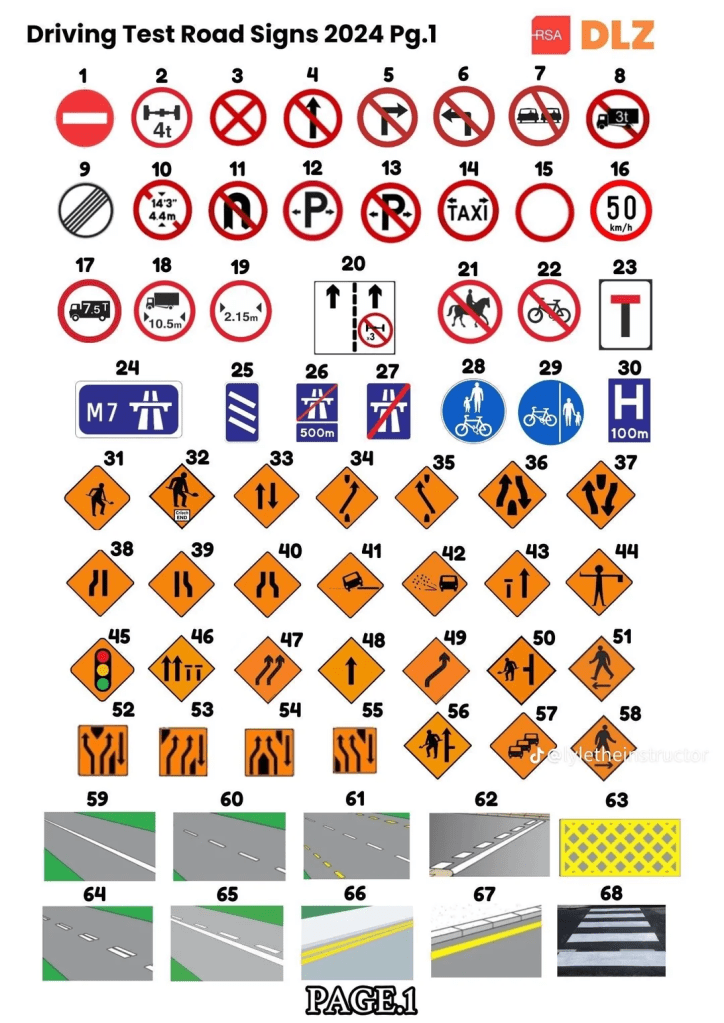
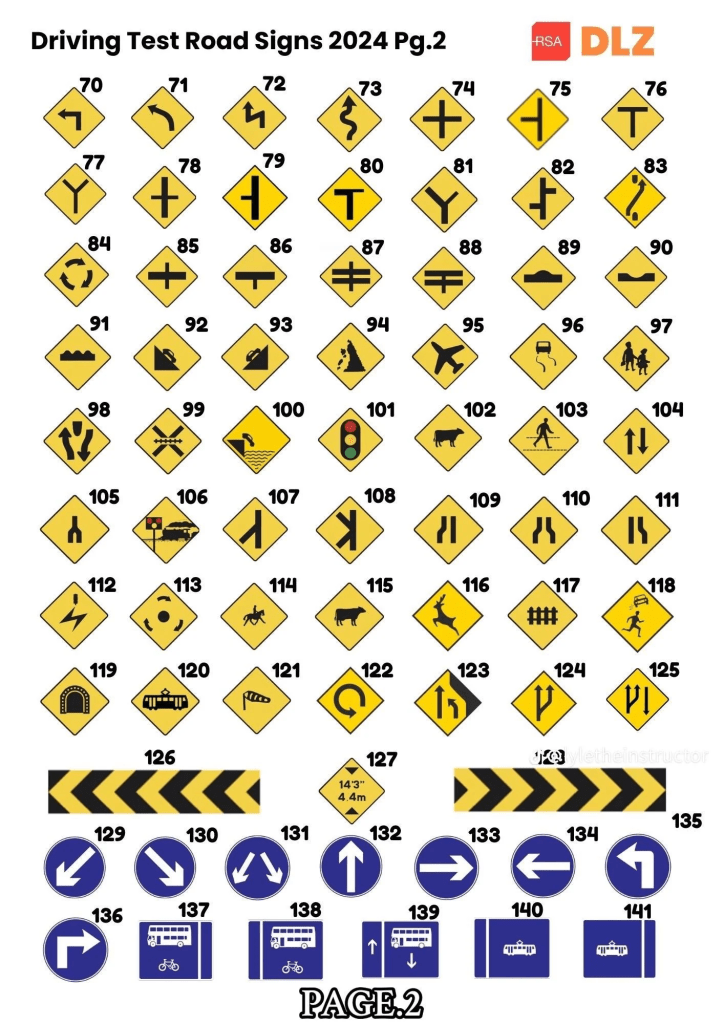

**Note** Rural speed limit change (Page 1 sign no.9) is now 60km/h since Feb 7th 2025
 A C Driving Tuition